
Why Anchor Selection Matters — and Why It Must Happen at Order Time
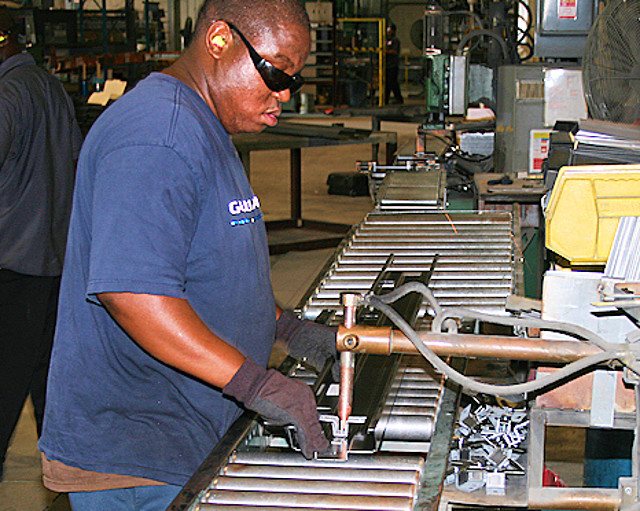
Frame anchors are the mechanical connections between the hollow metal frame and the surrounding wall construction. They are factory-welded to the frame during manufacturing — they are not field-applied hardware. This means the anchor type must be specified when you place your order, based on the wall type described in the architectural drawings.
Ordering the wrong anchor type creates a significant problem: the frame arrives with anchors that don't work with the actual wall construction on site. Field modification of factory-welded anchors is difficult, can compromise the frame's structural integrity, and may void the manufacturer's warranty. In fire-rated assemblies, unauthorized modifications can void the listing. Getting the anchor type right before the order ships is the only clean solution.
Floor Anchors
Floor anchors are the most universally required anchor type and are used in combination with other anchor types on virtually every frame installation. A floor anchor is a steel clip or plate welded to the base of each jamb that provides a positive stop at the bottom of the frame and anchors the jamb to the floor substrate below.
Floor anchors serve a dual purpose: they prevent the frame from shifting laterally once installed, and they provide a fastening point to the concrete slab or wood subfloor. They are drilled and fastened with powder-actuated fasteners or concrete screws at installation. Floor anchors are required for nearly all applications — their absence is a common cause of frame racking over time, particularly in high-traffic openings.
Strap Anchors
Strap anchors are flat steel straps welded to the back of the frame at intervals along each jamb and the head. They extend into the wall and are the primary method for securing the frame to the wall structure. Strap anchors are used in both masonry and stud wall applications:
- In masonry construction — Strap anchors are embedded in the mortar joints as the masonry is built up around the frame. The strap tail is bent into the mortar bed, providing mechanical lock as the mortar cures.
- In metal or wood stud construction — Strap anchors are screwed directly to the stud framing on each side of the opening. The strap tail is trimmed or bent to fit against the stud face and fastened with self-drilling or wood screws.
Strap anchors are a versatile, widely used anchor type that works across multiple wall types when properly specified and installed.
Wire / Projection Anchors
Wire anchors (also called projection anchors or loop anchors) are adjustable wire loops or rod projections welded to the frame back. They are used almost exclusively in masonry construction and are specifically designed for the masonry set-and-build sequence:
- The frame is set in the rough opening and braced plumb and square.
- The masonry is laid up around the frame, with wire or projection anchors embedded in mortar joints as the courses rise.
- The adjustable nature of the wire allows the mason to accommodate minor variations in joint spacing without perfectly aligning anchor locations with mortar beds.
Wire anchors are preferred over strap anchors in many masonry applications because they provide adjustment — the wire can be bent to align with the mortar joint regardless of its exact height relative to the frame's anchor weld location. This tolerance reduces installation conflicts and improves final frame alignment.
Jamb Anchors (Clip-Type)
Jamb anchors, also referred to as clip anchors or stud clip anchors, are formed steel clips welded to the frame back that clip directly onto the face of a metal stud or fasten to a wood stud. They are faster to install than strap anchors in light framing applications and do not require bending or trimming in the field.
Clip-type jamb anchors are commonly used in drywall stud construction where the frame is set before drywall is applied. They provide a positive, repeatable connection to the stud without the variability of field-bent straps. For metal stud applications, ensure the clip width matches the stud flange dimensions to achieve the designed engagement.
T-Strap and Base Anchors for Demanding Applications
Two additional anchor types are worth knowing for specialized applications:
- T-strap anchors — An extended strap with a wider "T" profile at the embedded end, used in masonry where additional pull-out resistance is needed. The wider tail provides more surface area for mortar bond, making it appropriate for frames in high-stress locations — loading dock doors, heavy-use institutional openings, or doors subject to significant impact.
- Base anchors (heavy-gauge plate) — Heavy steel plates welded at the base of the frame jambs for high-security or extra-stability applications. Common in detention, correctional, and other high-security construction types where frame stability under forced-entry attempts is a design consideration.
Anchor Spacing Standards
Anchor quantity and spacing for hollow metal frames are governed by NAAMM HMMA 830, the industry standard for hollow metal frames. Key requirements include:
- One anchor per jamb within 12" of the head (top of jamb)
- Maximum 2'0" spacing between anchors along the jamb height thereafter
- One anchor per jamb within 12" of the floor (above the floor anchor)
- Head anchors as required by wall type and frame depth
Frames manufactured to NAAMM HMMA 830 will have anchors factory-installed at compliant spacing. Verify this compliance when accepting any frame for use in a project governed by a specification that references HMMA 830.